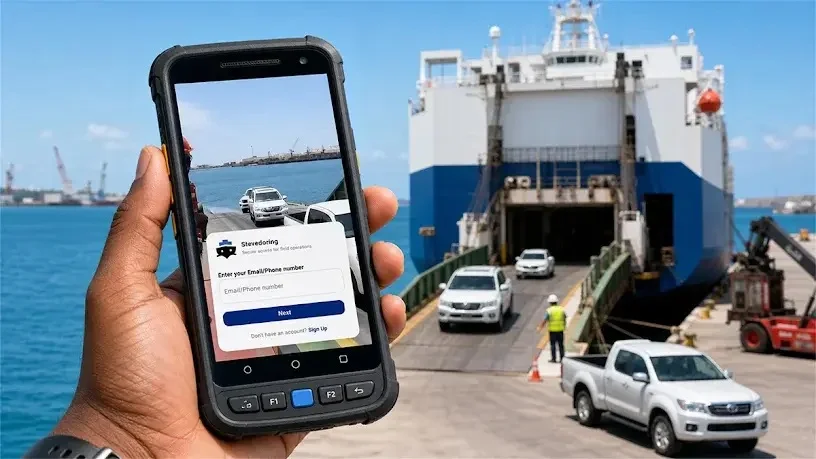
DigiCargo, a South African software company focused on port operations, is replacing paper-based vehicle tallying with a mobile platform designed for roll-on/roll-off (RoRo) freight operations. Founded in 2023 by James Zwane and Marlon Murahwa as a spin-off from software OEM Pace Online, the company moved its Stevedoring App into full production in 2024.
The first deployment took place in Port Elizabeth in January, followed by East London and Durban. DigiCargo has since recorded more than 700,000 vehicles across the three ports, according to Marlon Murahwa. The company's main customer is SA Cargo Services, which imports and exports new vehicles through South African ports.
The platform emerged from an earlier project developed by Pace Online. In 2018, the company presented a mobile tally concept to SA Cargo Services after the customer identified problems associated with paper-based processes. The initial solution focused on scanning vehicles, but the team later expanded the concept into a broader terminal platform and eventually a software-as-a-service model.
As reported by ITWeb, Murahwa said the move beyond vehicle counting came from the need to address operational issues that could not be solved by digitizing the tally alone.
“That’s what pushed us from a counter to a terminal platform, and eventually to software-as-a-service (SaaS),” Murahwa says.
The Stevedoring App allows quay-based tally clerks to identify vehicles through vehicle identification number scans, barcodes, QR codes, camera input or manual entry. A tally takes about three taps and nine seconds, while the application also records the vehicle's location and driver.
The application can work without an active network connection. Data is stored on the device and synchronized when connectivity becomes available, a feature designed for port environments where connectivity can be unreliable.
Multiple crews can also record vehicles on the same vessel at the same time. Their data is consolidated through a web dashboard that uses artificial intelligence to provide supervisors with operational visibility.
The platform includes digital representations of shipping yards and vessel decks. Teams can attach GPS data, video, images, voice and text to incidents and exceptions. Its dashboard can also use AI to read shipping documents, identify vessels and map shipping yards.
For system connectivity, DigiCargo supports webhooks, REST APIs and the Model Context Protocol.
The company says its approach is aimed at smaller and mid-sized port operators that may not be able to justify the cost and implementation timelines associated with larger terminal operating systems.
“RoRo operations at South African ports were being run on paper tally sheets. Not for lack of ambition – the alternatives were heavyweight terminal operating systems quoting multi-year rollouts and six-figure licences, which a mid-size operator cannot justify,” Murahwa says.
According to Murahwa, paper-based tallying can also contribute to errors, mis-shipments and disputes between terminals, shipping agencies and shipping lines. RoRo operations present a particular challenge because vehicle counts do not have an equivalent to the standardized TEU measurement used in container shipping.
“In RoRo, the count itself is often still on paper,” he says. “That means no single source of truth between terminal, agency and shipping line, reconciliation at end of shift or end of voyage, disputes settled from carbon copies, and invoices raised off numbers nobody can independently audit.”
The platform is currently used in operations involving shipping lines and manufacturers including K Line, MOL, EUKOR, Sallaum, Wallenius Wilhelmsen, Höegh, Hyundai Glovis and NYK.
DigiCargo is also discussing potential deployments in Ghana and plans to participate in the West Africa Trade Show in Accra this month. Its expansion strategy starts with Southern Africa and extends to West Africa, East Africa and the Middle East.
The company plans to continue developing AI capabilities for tasks such as reading shipping documents and legacy data, as well as eventually recognizing cargo at port sites.
Its SaaS model is designed to allow operators to subscribe to the platform, configure it and deploy it without lengthy procurement processes. The software runs on existing smartphones and rugged scanners and does not require additional port-side infrastructure.
Murahwa says the company intends to take the technology developed for South African port operations into other markets.
“This is African-built software solving an African operational problem, and we intend to export it rather than import a solution,” he says.
“Standardisation is exactly what a widely adopted platform creates. That’s the opportunity, and there’s no reason the company that captures it can’t be based here.”