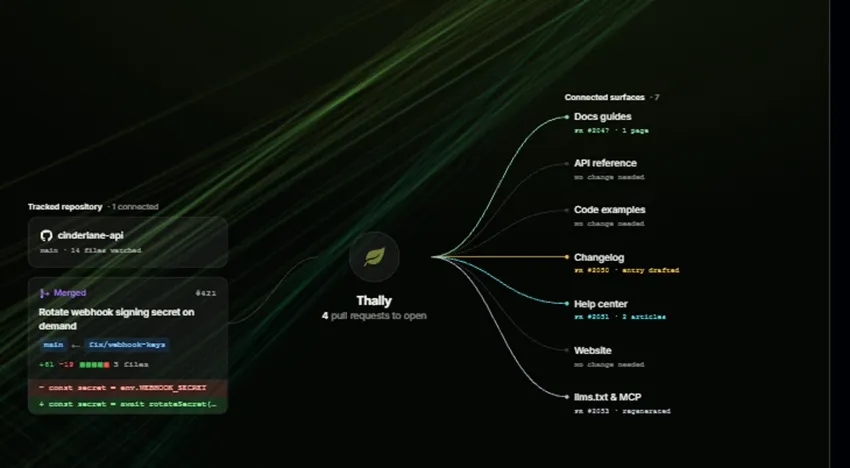
Nigerian startup Thally has launched a platform designed to keep product documentation and other customer-facing content aligned with software changes. Founded by Ekene Eze, Thally connects a team’s product repositories with the content repositories it wants to maintain, then identifies which information needs to change when the product is updated.
The platform generates pull requests with the proposed content changes and supporting evidence, allowing teams to review the source of the information, edit the updates and approve publication. The approach is intended to address cases where a software change affects several pieces of customer guidance but only some of them are updated.
“For example, changing an authentication flow could affect an API reference, a quickstart, a support article, and a code example in a blog post. Updating just the API reference would leave people following outdated instructions elsewhere. Thally finds and updates the affected connected content,” Eze told Disrupt Africa.
Thally also provides a documentation platform with search, custom domains, versioned deployments, rollbacks and AI assistants. Documentation can be accessed through a browser or by AI tools using Markdown, JSON and MCP.
Eze said the product grew from his experience working on developer experience and dealing with the work required to keep product information aligned with software releases. Before starting Thally, he said he would review product material, tickets, changelogs and code changes to determine which public-facing content needed to be updated.
That process became more difficult as software teams increased the pace of development. According to Eze, missed updates can leave outdated documentation online and give customers or AI tools access to instructions that no longer reflect the product.
“As teams use AI coding assistants to ship faster, there is more change to keep up with and less time to investigate each release manually,” said Eze.
“The outdated information remains online, where both customers and AI tools can still find it. That creates a feedback loop. An AI assistant can read a forgotten guide and generate a new integration using a method that has already been deprecated. A missed content update can become a broken integration, extra support work, or lost customer trust.”
Thally is fully bootstrapped. The company released a beta in August and launched publicly this month, after working with design partners including Hackmamba.io, Procta.org and LI.FI.
The company says it now has more than 100 active workspaces, while at least 100 workspaces are going through its 14-day free trial. Thally has users in the US, Europe, India, the Middle East and Africa.
Its business model combines an open-source documentation engine with paid cloud subscriptions.